
Home > News > Industry News > Diamond Wire Multi-Wire Cutting Technology: A Comprehensive Guide to Precision Manufacturing
Multi-wire diamond cutting and single-wire diamond cutting are not competitors — they are matched to different production realities. A multi-wire system runs several hundred wires in parallel and can process 2,000–5,000 wafers per hour at a thickness variation of ±5–15 μm, but it costs $500,000–$2,000,000 and only cuts straight, parallel paths. A single-wire system costs a fraction of that, handles contours and variable geometry, and becomes the more economic choice below roughly 1,000 units a month.
The decision rule is straightforward: high volume plus standard geometry favours multi-wire; low volume, complex geometry or very high material value favours single-wire.
As manufacturing pushes toward thinner wafers, tighter tolerances and more expensive materials, the choice of cutting architecture starts driving the unit economics of the whole line. Diamond wire saw cutting sits at the centre of that shift, and within it there are two very different machines: the multi-wire system, which divides one workpiece into hundreds of slices at once, and the single-wire system, which cuts one precise path at a time. This guide sets out the principles behind multi-wire cutting, its verified performance numbers, the limitations that decide where it stops making sense, and the selection rules that tell you which architecture your production volume actually calls for.
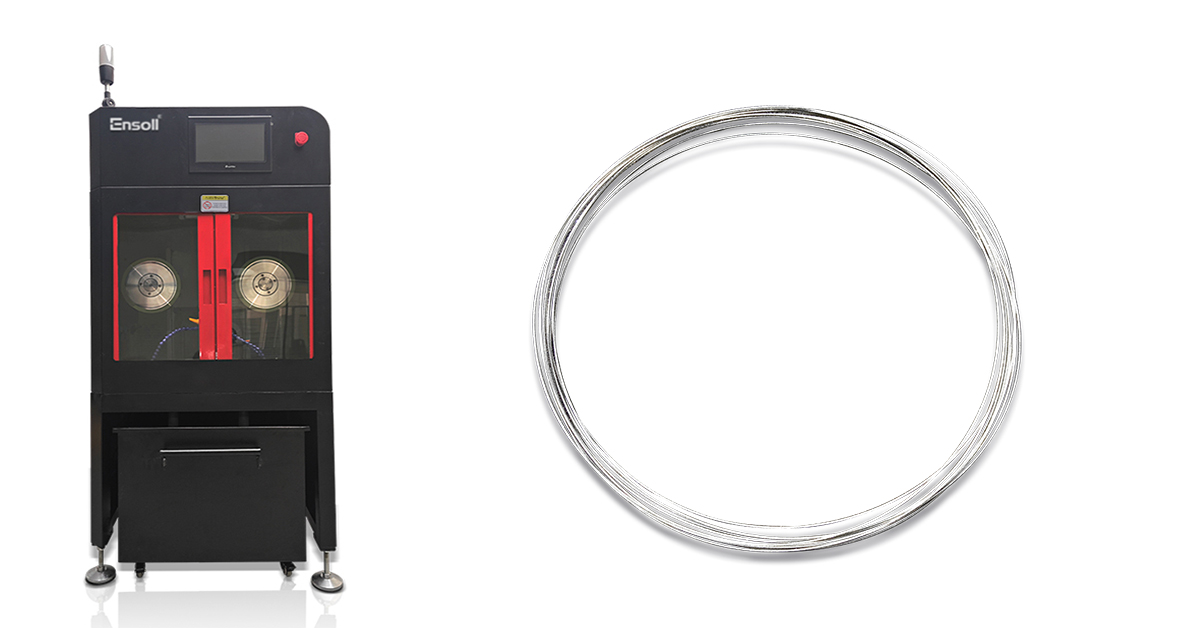
A diamond wire saw represents a significant technological leap in cutting methodology, utilizing an endless diamond wire — a continuous loop embedded with synthetic diamond particles as the primary cutting medium. The fundamental construction consists of a high-tensile strength core wire, typically made of high-carbon steel or tungsten, coated with precisely sized diamond particles through advanced electroplating or sintering processes. These diamond particles, ranging from 20 to 50 micrometers in diameter, function as microscopic cutting teeth that progressively abrade the material through controlled mechanical action.
The cutting mechanism operates through a sophisticated combination of precise wire movement, optimal tension control, and efficient cooling systems. As the diamond-impregnated wire moves at controlled velocities between 10-20 m/s, each diamond particle engages with the workpiece material, creating micro-fractures and removing material through a combination of brittle fracture propagation and fine abrasion. This process is continuously supported by cooling systems that serve the dual purpose of temperature management and efficient debris removal from the cutting zone.
The effectiveness of diamond wire cutting stems from diamond’s exceptional physical properties, ranking as the hardest known natural material with a Mohs hardness of 10. This extraordinary hardness, combined with precise engineering of wire parameters, enables clean, precise cuts with minimal material loss. The cutting process involves careful balance of multiple parameters including wire tension (typically 15-25N), cutting speed, feed rate, and cooling efficiency to achieve optimal results across different materials.

Watch the cutting demonstration on our YouTube channel
Multi-wire cutting represents the pinnacle of high-volume precision cutting technology, employing multiple diamond wires arranged in parallel configuration on large, precision-engineered guide rollers. This sophisticated arrangement enables simultaneous processing of multiple workpieces or the division of large materials into numerous slices in a single operation. The system’s architecture features synchronized movement of all wires, maintained under consistent tension, ensuring uniform cutting performance across the entire wire array.
The typical multi-wire system incorporates several hundred wires operating simultaneously, spaced according to the required final thickness of the sliced materials. This configuration demonstrates exceptional efficiency in processing standard geometric patterns, particularly straight cuts through large-volume materials. The technology has found its strongest application in industries where production volume and consistency outweigh the need for cutting path flexibility.
Multi-wire diamond cutting technology offers several compelling advantages that make it indispensable for specific industrial applications:
The most significant advantage of multi-wire systems lies in their exceptional throughput capability. By processing hundreds of wafers or components simultaneously, these systems achieve production volumes unattainable through single-wire alternatives. In photovoltaic silicon wafer production, for instance, modern multi-wire machines can process 2,000-5,000 wafers per hour, dramatically reducing production time and manufacturing costs per unit.
The synchronized nature of multi-wire cutting ensures identical cutting parameters across all wires, resulting in exceptional consistency throughout production batches. This consistency manifests in uniform thickness distribution (typically ±5-15 μm variation), consistent surface characteristics, and reliable mechanical properties across all processed components. This level of consistency proves particularly valuable in semiconductor and solar industries where component performance directly correlates with dimensional accuracy.
Through precise wire spacing and controlled cutting parameters, multi-wire systems achieve superior material utilization efficiency. The technology enables kerf losses as low as 120-200 μm, significantly improving material yield compared to traditional cutting methods. This advantage becomes increasingly crucial when processing expensive materials such as semiconductor-grade silicon or advanced ceramic compounds.
These are the figures that decide whether a multi-wire line pays for itself. They are also the figures an equipment budget should be built on.
| Parameter | Typical multi-wire value |
|---|---|
| Wires per system | Several hundred, spaced to the target slice thickness |
| Throughput (PV silicon) | 2,000 – 5,000 wafers per hour |
| Thickness variation | ±5 – 15 μm across the wire array |
| Kerf loss | 120 – 200 μm |
| Wafer thickness held | 160 – 180 μm (photovoltaic), down to <10 μm TTV on 300 mm semiconductor wafers |
| Capital investment | $500,000 – $2,000,000 depending on configuration |
| Economic volume threshold | Above roughly 10,000 units per month |
| Setup and changeover | 2 – 4 hours |
| Power consumption | 20 – 40 kW in operation |
| Coolant consumption | 50 – 100 litres per minute |
| Minimum wire spacing | Typically above 0.5 mm |
| Maximum cutting depth | Generally under 400 mm |
The solar energy industry has embraced multi-wire diamond cutting as the standard technology for silicon wafer production. The technology’s ability to maintain precise thickness control (typically 160-180 μm) while processing thousands of wafers hourly has been instrumental in reducing solar energy costs. Manufacturers report 30-40% reductions in processing costs alongside 45% improvements in material utilization compared to conventional slurry-based cutting methods.
In semiconductor manufacturing, multi-wire cutting enables production of 300mm wafers with thickness variations below 10 μm. The technology has proven particularly valuable for processing advanced semiconductor materials including silicon carbide (SiC) and gallium nitride (GaN), where conventional cutting methods struggle with material hardness and brittleness challenges.
Despite its impressive capabilities, multi-wire cutting technology is not the right answer for every shop. Four constraints decide whether it pays off — capital intensity, cutting-path flexibility, maintenance complexity, and the production volume required to amortise the machine. Each is examined in full, with figures, in Key Limitations and Challenges of Multi-Wire Diamond Cutting Technology below. If any one of them applies to your work, a single-wire machine is usually the better purchase.
Watch the cutting demonstration on our YouTube channel
While multi-wire systems dominate high-volume production, single-wire diamond cutting maintains distinct advantages in several critical applications:
Single-wire systems excel in applications requiring intricate shapes, contour following, or variable angle cutting. The technology’s flexibility enables customized cutting paths that would be impossible with multi-wire configurations, making it ideal for prototype development and specialized component manufacturing.
For production volumes below 1,000 units monthly, single-wire systems typically demonstrate superior economic efficiency. The technology’s lower initial investment, reduced maintenance complexity, and faster setup times provide compelling advantages for small-batch production and research applications.
When processing expensive materials where kerf loss minimization is critical, single-wire systems offer superior performance. The technology’s ability to optimize cutting paths for individual components significantly reduces material waste, providing substantial cost savings when working with precious materials.
Production volume analysis
Material considerations
| Your situation | Recommended architecture | Why |
|---|---|---|
| More than 10,000 units per month, standard geometry | Multi-wire | Throughput per hour is the dominant cost driver and the capital cost amortises |
| 1,000 – 10,000 units per month | Analyse case by case | Material value and geometric complexity decide; the crossover is not fixed |
| Below 1,000 units per month | Single-wire | Lower capital cost, faster setup and far lower maintenance burden |
| Complex contours or variable angle cuts | Single-wire | Parallel wire arrays can only make straight, parallel cuts |
| Prototype and R&D work | Single-wire | Frequent changeovers make multi-wire setup time uneconomic |
| Very high-value material where kerf loss dominates | Single-wire | Cut paths can be optimised per component to minimise waste |
| Standardised material, extremely high volume | Multi-wire | Consistency across hundreds of wires is exactly the strength of the architecture |
Successful multi-wire deployment
Organizations considering multi-wire implementation should focus on:
The diamond wire cutting landscape continues to evolve with several promising developments:
Multi-wire diamond cutting systems require substantial financial investment, with advanced machines typically ranging from $500,000 to $2 million. The significant costs extend beyond initial acquisition to include:
The parallel wire configuration inherently restricts processing capabilities:
Multi-wire systems demand sophisticated operational protocols:
Precision and Quality Challenges:
Material Processing Restrictions:
Volume and Efficiency Limitations:
Operational Challenges:
Financial Implications:
Strategic Limitations:
Flexibility and Precision:
Operational Efficiency:
Diamond wire multi-wire cutting technology represents a sophisticated solution for high-volume precision manufacturing, offering unparalleled production efficiency for standardized cutting applications. However, understanding the technology’s limitations is equally crucial for appropriate implementation. Single-wire systems maintain vital importance for specialized applications requiring flexibility, complex geometries, or lower production volumes.
The optimal choice between these technologies depends on comprehensive analysis of production requirements, material characteristics, economic considerations, and long-term strategic objectives. Both technologies continue to evolve, offering manufacturers increasingly advanced solutions for precision cutting challenges across diverse industrial applications.
Q1: What is multi-wire diamond cutting?
It is a cutting architecture in which several hundred diamond wires are mounted in parallel on precision guide rollers and move in a synchronised, tension-controlled array. One pass therefore produces hundreds of slices at once, which is why it became the standard method for photovoltaic silicon wafering and high-volume semiconductor work.
Q2: How much faster is multi-wire than single-wire cutting?
On photovoltaic silicon, a modern multi-wire machine processes 2,000–5,000 wafers per hour — volumes no single-wire system can approach. The comparison is not like-for-like though: multi-wire achieves that volume on straight parallel cuts, so the speed advantage only exists where the geometry allows it.
Q3: When does multi-wire cutting stop being worth the investment?
Below roughly 10,000 units per month the capital cost stops amortising, and the 2–4 hour setup and changeover time makes frequent product changes uneconomic. Single-wire systems also win whenever the cut path is not straight, because a parallel array physically cannot follow a contour.
Q4: What are the main maintenance challenges?
They all stem from running hundreds of wires at once: tension has to be managed across the whole array, wires need synchronised replacement, individual wire failures require diagnostic systems that can identify which wire has gone, and the machine demands specialised operator expertise. Multi-wire systems also use 20–40 kW in operation and 50–100 litres of coolant per minute, so utilities and fluid management are part of the maintenance picture.
Q5: Do both methods coexist in the same factory?
Frequently yes. Plants producing high-volume standardised product on multi-wire lines often keep single-wire capacity alongside them for prototypes, complex-geometry parts and expensive materials where kerf loss outweighs throughput. The two architectures are complements, not replacements.
Ensoll Tools offers free test cutting and equipment evaluation support: send us your material, target slice thickness and monthly volume, and we will return a cut sample with surface and kerf data plus an honest read on whether a multi-wire or single-wire architecture suits your production. We build endless diamond wire cutting machines from 0.5 m² laboratory units to large-format gantry systems, and we will tell you when the smaller machine is the right answer. Call +86-19937798228 or send your details through the contact page.
If you have any question, please contact us