
Home > News > Industry News > Why Premium Clubs Use Diamond Wire Cutting
Premium golf club manufacturers use diamond wire cutting on graphite shafts because it separates carbon fiber instead of tearing it. An abrasive wheel pushes lateral force into the shaft and generates cutting temperatures above 300°F, which damages the epoxy matrix and changes the flex, torque and kick point the shaft was engineered to deliver. A diamond wire exerts near-zero lateral pressure and cuts at under 90°F, so the shaft keeps its specified flex profile and every cut is perpendicular — which is why two clubs from the same production run finally feel identical.
The visible difference is a price difference: diamond wire systems cost far more to buy and run, so they appear on premium and custom-fitting lines rather than on mass-market shafts.
You buy two clubs built to the same specification, and they still feel different. The reason usually has nothing to do with the grip or the shaft band — it is the cut. Graphite shafts are layered carbon fiber in a resin matrix, and how that structure is separated at the butt and tip decides whether the flex profile, torque rating and kick point you were fitted for survive manufacturing intact. Conventional abrasive wheels tear the fibers and heat the epoxy; the endless diamond wire abrades through the shaft at near-zero lateral pressure and under 90°F, which is why premium club makers have adopted it as much for consistency as for cut quality.
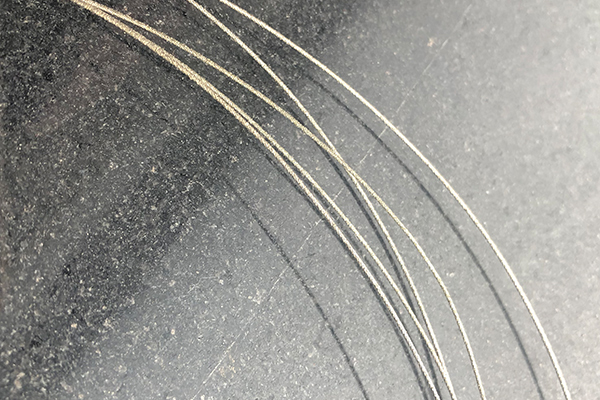
When you’re spending $500-$1000 on a premium driver or custom iron set, you’re right to expect perfection. Every aspect of the club should work in harmony to deliver optimal performance. Yet many golfers don’t realize that the cutting method used in shaft manufacturing can significantly impact both performance and durability.
Traditional cutting methods, while cost-effective for mass-market clubs, simply cannot deliver the precision required for high-end equipment. The difference lies in what happens at the microscopic level during cutting – and how those microscopic imperfections translate to macroscopic performance variations on the course.
Modern graphite shafts represent marvels of materials engineering. Through sophisticated layering of carbon fibers and specialized resins, manufacturers can precisely tune:
However, this sophisticated construction becomes a manufacturing challenge. Think of a graphite shaft as a carefully organized bundle of carbon fibers suspended in a protective resin matrix. When you cut this complex structure with traditional abrasive wheels, you’re essentially tearing through it rather than cleanly separating it.
The three defects below are the ones club fitters actually trace back to the cut, not to the layup.
| What happens at the cut | Conventional abrasive wheel | Endless diamond wire |
|---|---|---|
| Force on the carbon fibers | High lateral pressure tears fibers and pulls them out of the matrix | Near-zero lateral pressure; fibers are abraded, not torn |
| Cutting temperature | Often exceeds 300°F — hot enough to alter the epoxy | Held below about 90°F by integrated coolant, so the resin is unchanged |
| Damage beyond the cut line | Microscopic fractures extend past the kerf and become failure points | Damage confined to the kerf; no delamination |
| Perpendicularity | Angle variation is difficult to eliminate | Computer-controlled cut, consistently perpendicular |
| Effect on the club | Flex, torque and lie angle drift from the fitted specification | The specification you were fitted for is the specification you receive |

Many golfers assume that all cutting methods are created equal. The reality is quite different. Traditional cutting approaches introduce three critical problems that directly affect your game:
The high-speed friction of abrasive wheels literally tears carbon fibers apart, creating microscopic fractures that extend beyond the cut line. These fractures become failure points that can develop into full breaks over time, especially for players with higher swing speeds. When you’re paying premium prices, you shouldn’t have to worry about hidden structural weaknesses.
The intense heat generated by traditional cutting methods (often exceeding 300°F) actually changes the chemical structure of the epoxy resin that binds the carbon fibers. This thermal degradation alters the shaft’s flex characteristics, meaning the club you’re playing with doesn’t match the carefully engineered specifications you paid for. The result? Inconsistent performance that no amount of swing adjustments can fully compensate for.
Conventional cutting can’t guarantee perfect perpendicularity. Even a slight angle variation affects how the shaft seats in the hosel, changing the club’s lie angle and face orientation. This manufacturing variance explains why two “identical” clubs from the same manufacturer can feel and perform differently.
endless diamond wire technology represents the solution to these manufacturing challenges. Here’s how this advanced process protects your investment:
Unlike traditional methods that tear through materials, diamond wire cutting uses microscopic diamond particles to gently abrade through the shaft. The process exerts zero lateral pressure, eliminating the risk of delamination and fiber damage. Your expensive graphite shaft maintains its engineered structural integrity from end to end.
Integrated cooling systems ensure the cutting temperature never exceeds 90°F, completely preserving the epoxy resin’s chemical structure. This means the flex profile, torque rating, and kick point you selected based on your swing characteristics remain perfectly intact.
Computer-controlled precision ensures every cut is perfectly perpendicular. This manufacturing accuracy translates to consistent lie angles and face alignment across all your clubs – finally delivering the equipment consistency that serious golfers deserve.
When you invest in diamond wire-cut shafts, you’re not just paying for manufacturing bragging rights. You’re investing in tangible performance advantages:
The question naturally arises: if diamond wire cutting is superior, why isn’t every manufacturer using it? The answer lies in the significant cost difference. Diamond wire cutting systems are substantially more expensive to purchase and operate than traditional cutting equipment. The process is slower, requires more sophisticated technical expertise, and involves higher consumable costs.
For budget-conscious manufacturers producing mass-market clubs, these additional costs don’t make economic sense. But for premium club manufacturers – and for serious golfers who understand how equipment variations affect performance – the investment is absolutely justified.
As a discerning golfer, you now have a new criteria for evaluating premium clubs. When considering your next equipment purchase, ask these crucial questions:
The most respected club fitters and manufacturers are increasingly transparent about their manufacturing processes. Many now highlight their use of diamond wire cutting technology as a key differentiator for their premium lines.
Diamond wire cutting technology represents where premium golf equipment is heading. As golfers become more educated about how manufacturing choices affect performance, manufacturers are responding with greater transparency and better processes.
When you understand what happens during the cutting process, the price difference between mass-market and premium clubs starts to make perfect sense. You’re not just paying for marketing hype or cosmetic differences – you’re investing in preserved engineering integrity and measurable performance consistency.
Your search for equipment consistency and optimal performance shouldn’t end with swing weights and flex profiles. The manufacturing process itself plays a crucial role in determining whether you’re getting what you paid for. Diamond wire cutting technology ensures that the sophisticated engineering in premium graphite shafts translates directly to improved performance on the course.
For golfers who understand that every element matters, from grip selection to manufacturing methods, diamond wire cutting represents the new standard. It’s the assurance that your investment in premium equipment will deliver the consistent, reliable performance you need to play your best golf.
When you’re ready to make your next equipment investment, remember that true quality goes deeper than brand names and cosmetic appeal. The manufacturing precision that creates your clubs ultimately creates your performance experience. Choose the technology that honors your investment and supports your pursuit of golfing excellence.
Q1: Why does the cutting method change how a graphite shaft performs?
Because the shaft’s performance comes from the fiber layup and the resin that holds it. A cut that tears fibers or heats the epoxy changes both, so the flex profile, torque and kick point shift away from what the shaft was designed and fitted to do. Two shafts cut by different methods are not the same product even when the layup is identical.
Q2: What cutting temperature does each method reach?
Traditional abrasive-wheel cutting commonly exceeds 300°F at the cut, which is hot enough to chemically change the epoxy resin. Diamond wire cutting runs with integrated coolant and keeps the cutting zone below roughly 90°F, well inside the range where the resin is unaffected.
Q3: Does diamond wire cutting really eliminate delamination?
It removes the mechanism that causes it. Delamination starts when lateral force separates fiber layers from the matrix. Diamond wire abrades through the material without pushing sideways, so the layers stay bonded and the shaft keeps its structural integrity end to end.
Q4: Why do only premium clubs use diamond wire cutting?
Cost. Diamond wire systems are substantially more expensive to purchase and operate, the process is slower, and it needs more skilled operators and costlier consumables. That only makes economic sense where the customer is paying for measurable consistency, which is the premium and custom-fitting end of the market.
Q5: What should I ask a manufacturer about their shaft cutting?
Three questions: which cutting method is used on their premium shafts, how they verify consistency across a production line, and what quality control detects manufacturing variation. Manufacturers who have invested in diamond wire cutting generally answer all three, because the process is their differentiator.
Ensoll Tools offers free test cutting: if you manufacture or fit graphite shafts, send a shaft section or composite sample and we return the cut piece with surface data so you can compare fiber damage and cut squareness against your current process. Tell us the shaft material, the wall thickness and the cut length, and our engineers will specify wire diameter, grit and coolant parameters. Call +86-19937798228 or send your sample details through the contact page.
If you have any question, please contact us